
Inside Santoni Programming: From Concept to Circular
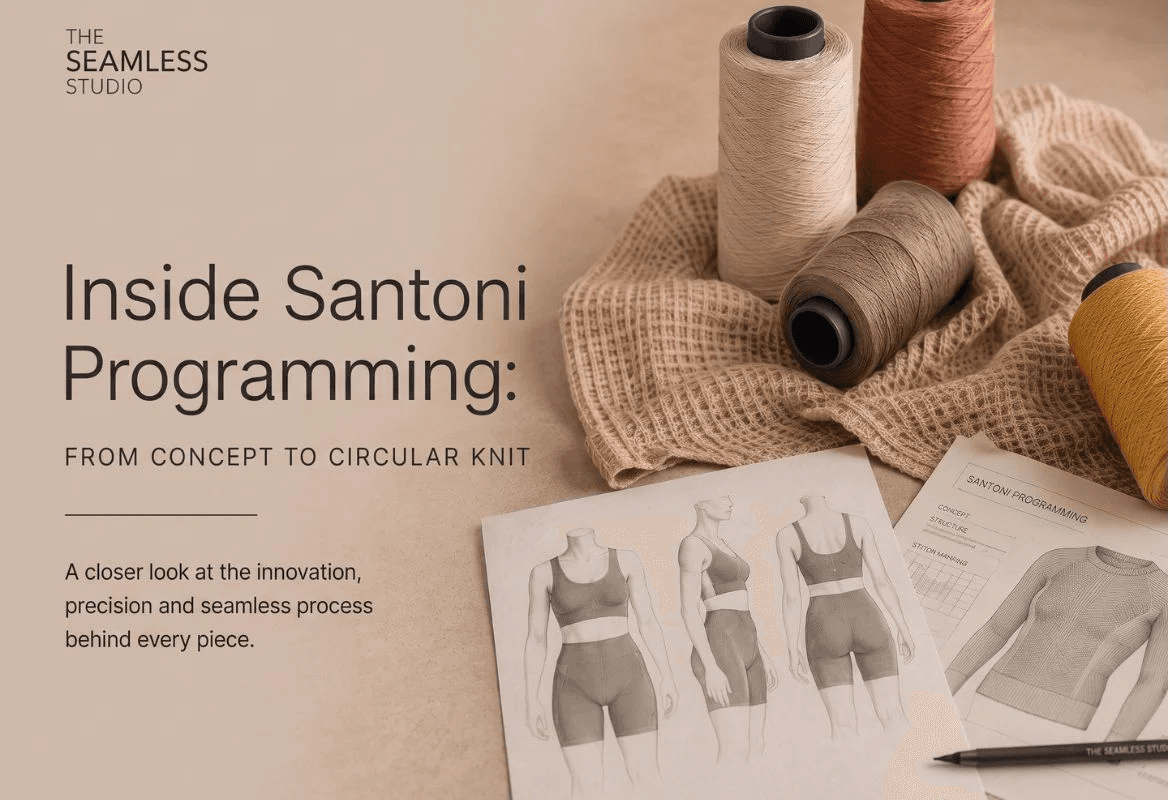
Every seamless circular knit garment starts as a story that hasn't been told in fabric yet. A brand comes to us with a problem to solve: a compression zone that keeps sliding, a waistband that digs in in mile three, a fabric that traps heat when it should be releasing it. Long before any of that reaches a factory floor, it has to become something far less glamorous and far more important: a program.
This is the part of seamless circular knit development that most people never see, and it's the part that decides whether a garment actually performs the way it was designed to.
/ Table of contents:
What “Programming” Actually Means
Santoni machines are circular knitting machines capable of producing a fully formed tube of fabric, and in many cases a fully formed garment, in one continuous knit. No cut panels, no side seams, no stitching two pieces of fabric together and hoping the seam holds up under load. The machine builds the structure as it knits.
But a Santoni machine doesn't know what a compression legging is. It doesn't know what “ventilation” or “body mapping” mean. It only knows instructions: which needles fire, in what sequence, at what tension, with what stitch structure, row by row, for tens of thousands of rows in a single production run. Programming is the act of translating a design intent into that exact sequence of machine instructions.
Get it right, and you get a garment with zones of compression exactly where an athlete needs support, mesh panels that open up airflow exactly where the body generates the most heat, and a knit structure that flexes with movement instead of resisting it. Get it wrong, and you get a garment that looks right on a spec sheet and fails on a body.
The Journey From Sketch to Machine
The process rarely moves in a straight line, and that's by design.
It starts with the brief: what is this garment supposed to do, who is wearing it, and what does “better” look like compared to what already exists in the market. From there, yarn selection and structure planning happen in parallel, because the yarn and the knit structure are not separate decisions. A yarn with the wrong elasticity will fight a compression structure. A yarn without the right moisture management will undermine a ventilation zone no matter how well it's engineered.
Once the structural intent is clear, the actual programming begins: translating panels, zones, and transitions into stitch-by-stitch machine logic. This is where deep technical experience matters most, because small adjustments in tension or stitch density can change how a fabric behaves entirely. This stage is iterative by nature. A first program almost never survives contact with a physical sample unchanged.
Samples come off the machine, get evaluated against the original brief, and get sent back for revision. This loop repeats until the garment does what it was designed to do, not just what it was drawn to look like. Only once that's locked does the program move toward production calibration, the process of making sure what worked on a development machine holds up consistently at scale, across shifts, across operators, across thousands of units.
Why This Stage Is the Real Product
It's worth being direct about something the industry doesn't always say out loud: the physical garment is not actually the most valuable thing coming out of this process. The program is.
A finished sample is one output. The program is the reusable, refinable asset that produced it, and that can go on to produce it again, better, at scale, and in variations. It encodes years of accumulated knowledge about how a specific fiber behaves under specific tension, how a specific stitch structure performs under specific load, and how to translate a designer's intent into something a machine can execute with precision. That's not something you sketch once and forget. It's a living technical document that improves with every revision.
This is also why we treat programming as a specialization, not a side function of manufacturing. Over two decades and more than 5,000 seamless circular knit styles, the patterns repeat but the solutions rarely do, because every brand's problem is slightly different, and every fabric performs slightly differently depending on what it's asked to do.
What This Means for a Brand Building Performance Product
If you're developing a seamless product, the program is where your actual differentiation lives, not in the fabric swatch, not in the color story, in the underlying logic that makes the garment behave the way it does on a body in motion. Treating that stage as an afterthought, or outsourcing it entirely to whichever factory happens to be running your order, means handing over the one part of the process where your competitive edge is actually built.
That's the thinking we bring to every development project: the program isn't a manufacturing detail. It's the product.
Seamless Fiberlynk
Santoni Tech
Yarn Innovation
Activewear
Circular Fiberlynk
Concept to Production
IP Ownership
Fiberlynk
Performance Wear
Sustainable Fibers
Textile Engineering
Global Sourcing
Compression Wear
Sports Bras
Cost Transparency