Why IP Ownership Changes the Game for Activewear Brands
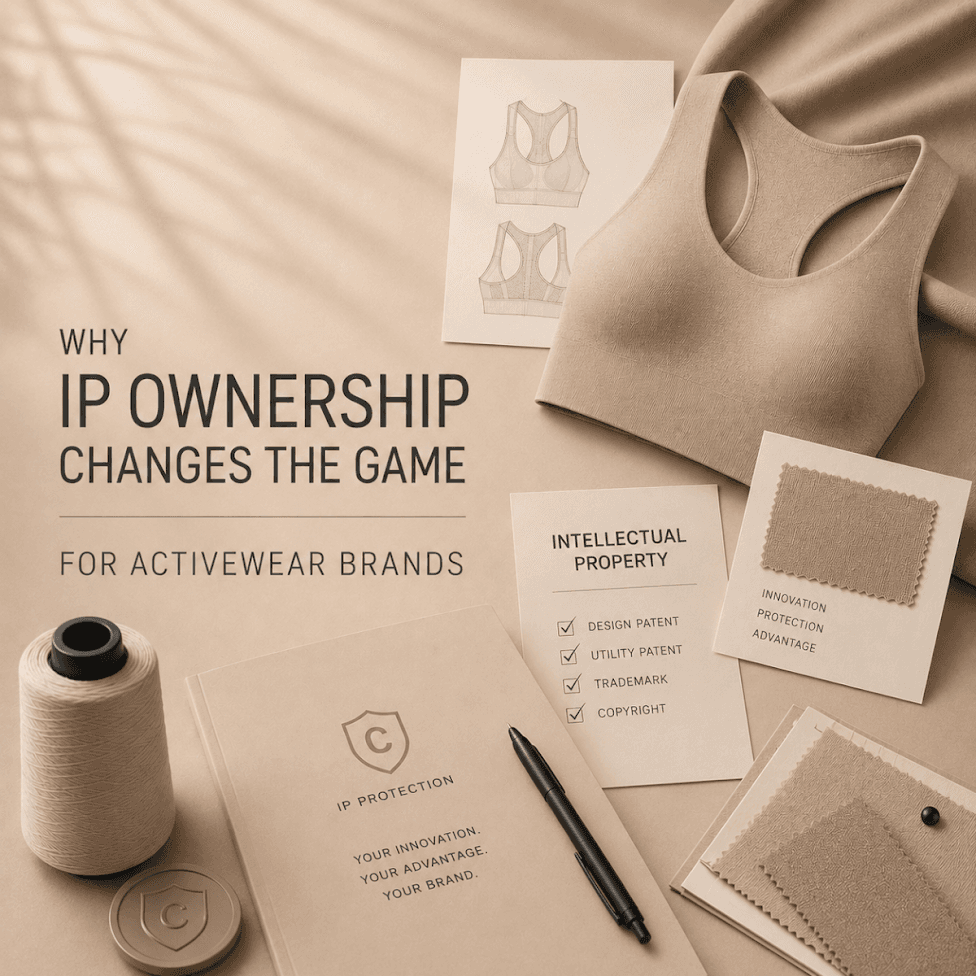
Most conversations about intellectual property in apparel focus on the visible things: logos, trademarks, maybe a patented fabric technology. Almost nobody talks about the asset that actually determines whether a brand controls its own product roadmap or is quietly dependent on a single factory relationship: the Santoni knit program itself.
This is the part of seamless circular knit development that rarely makes it into a pitch deck, and it's the part that has the biggest long-term impact on how much leverage a brand actually has.
/ Table of contents:
The Default Model Most Brands Don't Question
In a lot of seamless circular knit development arrangements, the knit program that produces a garment is developed inside the factory's own systems and never formally handed over as an owned asset. The brand gets the garment. The brand gets the fabric. The factory keeps the program.
On the surface this looks harmless, even efficient. The problem shows up later, usually at the worst possible moment: when a brand wants to move production to a second facility for capacity reasons, wants to renegotiate pricing, or runs into a quality or delivery issue with an existing partner. Without the program, none of those moves are simple. The technical knowledge required to reproduce that exact garment, the compression zones, the ventilation panels, the stitch-by-stitch logic built over months of sampling and revision, doesn't travel with the brand. It stays with whoever built it.
That's not a manufacturing inconvenience. That's a brand losing control over its own product.
What Ownership Actually Changes
When a brand owns its Santoni programs outright, along with the yarn specifications and supplier relationships tied to them, the entire risk profile of scaling a seamless circular knit product line shifts.
Sourcing stops being a single point of failure. A program that belongs to the brand can move to any qualified manufacturing partner, whether that's for capacity reasons, geographic diversification, cost negotiation, or simply because a relationship has run its course. That optionality alone changes the negotiating dynamic with every factory a brand works with, because the leverage isn't one-sided anymore.
It also protects the actual innovation. A program developed through months of iteration represents real R&D, tension curves, stitch densities, and structural solutions that took real time and expertise to get right. If that program lives inside a factory that also produces for other brands, there's no real barrier stopping elements of that development from resurfacing elsewhere. Ownership draws a clear line around what's proprietary and what isn't.
And it changes how a brand thinks about its own roadmap. A program isn't just a file that produces one SKU. It's a foundation that can be refined, extended into adjacent products, and built on season after season. That compounding value only accrues to whoever owns the underlying asset. If it's not the brand, the brand is paying to build equity it will never fully realize.
Why This Is a Structural Decision, Not a Legal Footnote
It's easy to treat IP ownership as boilerplate, a clause to get right in a contract and otherwise not think about. In seamless development specifically, it's closer to a strategic decision about how much of your product's future you control.
A brand that owns its programs can walk into a manufacturing conversation from a position of choice. A brand that doesn't is negotiating from a position of dependency, whether or not that's ever said out loud.
This is why we build every development engagement around a simple principle: the IP belongs to the brand, full stop, allocatable to whichever manufacturing partner fits the brand's sourcing strategy, not locked to ours. Our job is to build the program with the technical rigor it deserves. Once it's built, it's yours to take wherever your business needs it to go.
Seamless Fiberlynk
Santoni Tech
Yarn Innovation
Activewear
Circular Fiberlynk
Concept to Production
IP Ownership
Fiberlynk
Performance Wear
Sustainable Fibers
Textile Engineering
Global Sourcing
Compression Wear
Sports Bras
Cost Transparency